
A hospital incident response plan fails when people don’t know who decides, what gets shut down, and how care keeps moving. If I were checking a NIST-based plan today, I’d look for four things first: clear scope, named decision-makers, step-by-step actions across the NIST lifecycle, and written reporting and review rules.
In plain English, a healthcare IR plan should show that you can:
- protect patient care and ePHI at the same time
- map response steps to NIST SP 800-61 and NIST SP 800-66r2
- declare incidents and assign severity levels
- contain threats without cutting off care tools like EHR, PACS, labs, and medical devices
- preserve logs, timelines, and chain-of-custody
- restore from trusted backups
- test interfaces like HL7 and FHIR before return to service
- complete HIPAA breach review, notices, and after-action fixes
A strong checklist is not about long policy language. It is about whether your team can make high-risk calls under pressure, document them, and get clinical systems back in the right order. The article boils that down into a simple review of governance, roles, execution, and post-incident follow-up.
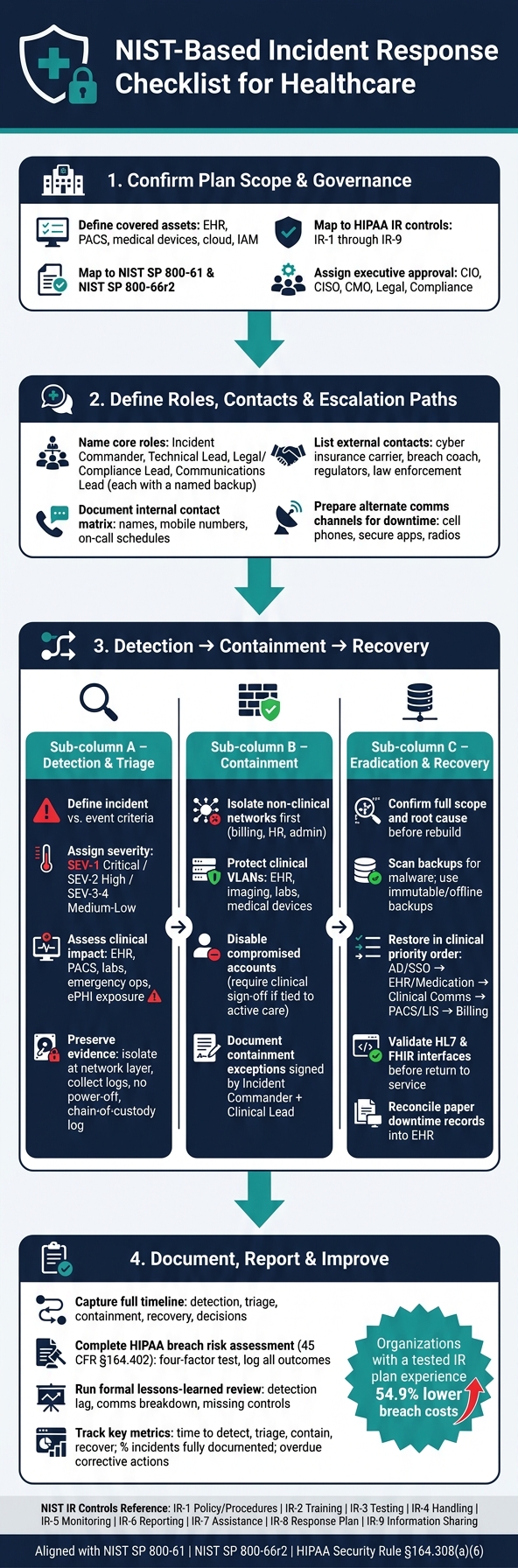
NIST-Based Incident Response Lifecycle for Healthcare Organizations
Managing Incidents with the NIST CSF 2.0
sbb-itb-535baee
1. Confirm plan scope, governance, and NIST mapping
Before you test any playbook, make sure the plan has a clear scope, clear decision rights, and a direct tie to NIST and HIPAA.
Define mission, scope, and covered assets
Start by stating what the plan is there to protect: patient safety, ePHI, clinical operations, and regulatory compliance.
NIST SP 800-66r2 says the incident response program must cover every part of the organization where ePHI is created, stored, processed, or transmitted [11][7]. That means you need a clear list of all in-scope assets, including EHRs, connected medical devices, PHI repositories, clinical applications, cloud services, third-party platforms, IAM systems, and core infrastructure. If anything is left out, document that exclusion and include a risk-acceptance reason.
Once the scope is set, the next step is simple: spell out who has the power to make each response decision.
Assign governance, authority, and executive approval
Name the people and roles tied to each part of incident response. That includes the policy owner, executive sponsor, incident declaration authority, escalation approvers, notification approvers, and incident-closure authority.
Document executive approval from the CIO, CISO, CMO, privacy, and compliance leaders, and include version numbers and sign-off dates [8][9]. Legal and compliance should review the plan against HIPAA Security Rule §164.308(a)(6) before it is approved [7][9]. Approval should be reviewed every year and after major changes, such as an EHR migration or a new cloud dependency [7][9].
The plan should also show how incident response governance connects with enterprise risk management, business continuity, disaster recovery, and privacy operations. These teams rely on many of the same systems and processes, so the plan should line them up clearly [14][2][16].
With governance in place, you can tie each part of the plan back to the right NIST and HIPAA requirement.
Map the plan to NIST and HIPAA requirements
Map each procedure, playbook, and workflow to the relevant NIST phase [10][12][13][15][2].
Then map the plan to the HIPAA-aligned incident response controls in NIST SP 800-66r2. The guide links incident response directly to nine IR controls - IR-1 through IR-9 - covering policy and procedures, training, testing, incident handling, monitoring, reporting, response assistance, the incident response plan itself, and information spillage response [7]. Doing this gives you an auditable record and makes gaps easier to spot, like weak testing coverage or thin monitoring coverage [7].
| NIST IR Control | What It Covers | HIPAA Alignment |
|---|---|---|
| IR-1 | Policy and procedures | §164.308(a)(6) administrative safeguards |
| IR-2 | Training | Workforce training requirements |
| IR-3 | Testing | Plan testing and exercises |
| IR-4 | Incident handling | Response and mitigation procedures |
| IR-5 | Monitoring | Ongoing security monitoring |
| IR-6 | Reporting | Internal and regulatory reporting |
| IR-7 | Response assistance | External support agreements |
| IR-8 | Incident response plan | Documented IR program |
| IR-9 | Information spillage response | PHI exposure and containment |
2. Define roles, communications, and escalation paths
Once governance is in place, the next step is simple: make it clear who does the work, who signs off, and who supports each role. In a live incident, vague ownership burns time fast.
Name the incident response team and decision rights
Every NIST-aligned healthcare incident response team should name its core roles in advance: incident commander, technical lead, detection lead, leadership sponsor, legal/compliance lead, and communications/public information lead, with a named backup for each [1][17]. Each role should have a short written description of its main duties.
The plan should also state who can declare an incident, assign severity, approve containment actions, authorize a system shutdown, notify regulators, and approve return to service [1][17][19][20]. If a high-stakes decision needs two approvers, say that plainly. The same goes for escalation authority, especially for high-impact choices like major-system shutdowns.
This is what turns governance from a chart on paper into an actual response chain.
Document internal and external contact paths
Contact lists need to stay current. The internal contact matrix should include names, roles, mobile numbers, backups, on-call schedules, and response times for every IR team member [19][20][2]. It should also cover department liaisons such as clinical, lab, imaging, registration, revenue cycle, and biomedical engineering. For critical incidents, the plan should require notice to the CISO, CTO, CEO, legal, communications, and affected department heads within severity-based response times defined in the plan [19].
External contacts matter just as much. At a minimum, the plan should list the cyber insurance carrier, designated breach coach, policy number, and claim contact, because cyber insurance policies often require notice within hours of a suspected breach [18]. It should also include contact paths for regulators and law enforcement when needed, with one person assigned to keep the list up to date.
Prepare alternate communications for downtime conditions
If your main communication systems go down, the team still has to talk. That answer should be written down before anything happens, not made up on the fly.
Define backup channels, such as personal cell phones, secure messaging apps, or radios, and spell out what each channel may carry, including any encryption needs and patient-safety notices under privacy limits, so staff know what can be shared, where, and by whom [18][2]. Pre-approved downtime communication workflows should cover these rules as part of normal incident procedures.
NIST also recommends naming a single media point of contact and at least one backup, along with procedures for handling press inquiries that match organizational policy [10]. External media questions should go through that spokesperson, with prepared statements ready in advance and reviewed by legal [18].
These communication paths need to support the step-by-step incident process in the next section. Once they are set, the plan can move into detection, containment, and recovery.
3. Build the execution checklist for detection, triage, containment, eradication, and recovery
Once roles and communication paths are set, the next step is to spell out the exact response actions. This section covers detection and analysis, containment, eradication, and recovery - the work the team does from the first alert to return to service.
Set incident criteria, severity levels, and evidence rules
Every response team needs the same starting point: a shared definition of what counts as an incident. A single failed login is an event. Repeated failed logins from multiple locations targeting privileged accounts - or any compromise of systems holding ePHI - is an incident.[21][24][25]
Use these severity tiers:
| Severity | Label | Clinical Impact Example |
|---|---|---|
| SEV-1 | Critical | EHR unavailable hospital-wide, PACS or imaging systems offline, medication administration systems down, lab result delivery delayed for the ED or ICU, or emergency communications impacted.[22][18][26] |
| SEV-2 | High | Billing or scheduling disrupted; outpatient portals down; current patients can still be treated safely.[18][26] |
| SEV-3/4 | Medium/Low | Single non-clinical workstation affected; no immediate patient impact but possible privacy or compliance exposure. |
For each alert, the checklist should force a clinical impact review. Does this affect current patient care? Does it touch imaging or labs? Does it affect emergency operations or on-call paging? Does it involve possible ePHI exposure or exfiltration? If the answer to any of those is yes, move the severity up.[22][26]
Evidence collection should start the moment the incident is declared, not after containment. The checklist should tell staff not to power off affected endpoints when malware is suspected. Instead, isolate them at the network layer, collect system and application logs from EHR, PACS, identity providers, and VPNs, do not delete suspicious files, and preserve copies or hashes. Keep a time-stamped incident timeline from the first alert through each major decision.[1][23][3]
A simple chain-of-custody log - who collected what, from which system, and when - helps with internal investigations and with any outside digital forensics team brought in later. That timeline also supports the documentation work in the next section.
Contain threats without disrupting critical care
Containment has to protect care delivery while stopping the threat from spreading. In practice, that means isolating non-clinical networks first - billing, HR, and administrative systems - while actively protecting clinical VLANs that support EHR, imaging, labs, and medical devices.[18][26]
For compromised accounts, immediate disablement should be the default, especially for privileged accounts and vendor remote-access accounts.[21][25][18] If an account is tied to active clinical operations, the checklist should require clinical sign-off before disabling it.
The same thinking applies to host isolation. The default move is to isolate suspicious endpoints through EDR or firewall controls without shutting them down. If a system is supporting a high-risk procedure - an anesthesia workstation in the middle of surgery, for example - the checklist should require direct coordination with the clinical lead before any power off, reboot, or reimage. Manual workarounds should be in place first.[18][26]
Those exceptions should not live in someone’s memory or in a hallway conversation. They need to be written down. A containment exception record, signed by the incident commander and the clinical lead, makes the response easier to defend during audits and regulatory review.[1][21][23]
Restore from trusted backups and verify systems, interfaces, and workflows before return to service
Eradication means confirming the threat is gone before recovery begins. A partly cleaned system is not enough. The checklist should require confirmation of the full scope of affected systems and the root cause of access - phishing, VPN, third-party vendor, medical device - before any broad rebuild starts.[21][23][25][26]
For major incidents such as ransomware, rebuilding domain controllers, critical servers, and endpoints from trusted system images is safer than trusting a compromised system that was cleaned up after the fact.[18][26]
Backup integrity comes next, and there’s no room to cut corners here. Scan backup data for malware before using it. If the attack sat in the environment for weeks, it may have reached online backup infrastructure too. That’s why immutable, offline backups are the safest source for restoration.[18][26]
Recovery order should follow clinical need first, not business convenience. Restore identity and access infrastructure first - Active Directory and SSO - then core EHR and medication administration modules, then clinical communications, then diagnostic systems such as PACS and lab information systems, and only after that business systems like billing and scheduling portals.[18][26]
Before clinicians start using any restored system, the checklist should require validation of HL7 and FHIR interfaces so teams can confirm that orders, results, and device data are moving the way they should. Medical devices should reconnect only after security validation and vendor confirmation that they can function safely.
Once systems are back online, the team must reconcile paper downtime records and manual orders into the EHR. That work needs clear ownership and a verification step before the incident can be closed.[1][21][23][3]
Record every action, decision, and timestamp for the documentation and lessons-learned phase that follows.
4. Maintain documentation, reporting, and continuous improvement
Capture timelines, decisions, and reporting obligations
After recovery, the work isn't over. This is the point where the incident has to become a defensible record and a set of concrete fixes. Document the full timeline: detection time, triage notes, containment, eradication, recovery, affected systems, evidence, and who made key decisions. Store logs securely, keep timestamps consistent, and retain records based on policy and legal hold rules. That record supports HIPAA reporting decisions and later audit review. [31][5][33]
For evidence, use a chain-of-custody form and hash each file or image before transfer. [29][30]
On the reporting side, the checklist should force a clear decision: does this event trigger HIPAA breach notification under 45 CFR §164.402? That means completing the four-factor risk assessment, deciding whether the PHI involved was secured or unsecured PHI, and documenting the final call either way. Even if the incident is not reportable, it still needs to be logged with dates, PHI involved, the risk assessment performed, and actions taken. Keep copies of all notices sent to individuals, media, and HHS, along with submission confirmation IDs and key dates. [28][31][34]
Run lessons learned and update the plan
Once reporting is done, move straight into lessons learned. Run a formal review on a set timeline, and keep the focus on fixes, not blame. Bring in incident response, clinical, compliance, privacy, and security leaders. [10][4]
Write down what failed so the next response is faster and safer. The review should answer a few direct questions:
- What worked?
- Where did detection lag?
- Which communications broke down?
- Which controls were bypassed or missing?
- What could have reduced the impact?
Include root-cause analysis and contributing factors, then assign each finding an owner, due date, and success measure. [10][4][30] If a ransomware event showed that recovery instructions were out of date, the fix isn't just updating the playbook. It means revising backup validation steps, retraining technical staff by a specific date, and adding a tabletop scenario that tests that failure path.
Track metrics that show whether the program is getting better: time to detect, time to triage, time to contain, time to recover, time to complete post-incident review actions, percentage of incidents with complete documentation, and number of overdue corrective actions. [27][30] Organizations with an incident response team that also tests the IR plan experienced breach costs 54.9% lower than organizations without those capabilities. [35] That's why lessons learned should be a standing program function, not a one-and-done exercise.
Use healthcare risk operations to keep the plan current
One of the hardest parts in healthcare is keeping an incident response plan from going stale. Vendor relationships shift. New clinical tools get added. Incidents expose gaps in playbooks that weren't obvious on paper. The checklist should ask whether the organization has a repeatable way to identify high-risk vendors, track open remediation items, and update playbooks as the threat landscape changes. [29][31][32]
Centralize vendor risk, enterprise risk, and benchmarking data so remediation items and playbook updates stay current; Censinet RiskOps™ can support that workflow.
Conclusion: A checklist for a defensible, healthcare-ready response plan
A good checklist should leave zero confusion about scope, authority, execution, or follow-up. A NIST-based incident response plan does not hold up in a crisis just because it looks good on paper. It has to work when people are under stress. That starts with a clear scope, meaning every system that handles ePHI, and a direct mapping of each response phase to both NIST SP 800-61 and HIPAA's Security Rule requirements.[10][36][39]
Authority also needs to be spelled out ahead of time. Decide in advance who can approve isolation, downtime, and escalation. When incident commanders are named, decision rights are documented, and escalation paths to executive leadership are clear, teams can move without confusion.
Detection, triage, containment, and recovery should be written as action checklists, not vague guidance. Severity levels, evidence preservation steps, and PHI breach assessment workflows need to be simple enough to follow in the middle of an incident. And every containment choice has to balance cyber risk reduction with patient safety and clinical continuity. In healthcare, that tradeoff is never abstract.
Recovery is only one stage of the work. After systems are back, attention shifts to documentation and fixing what failed. Post-incident review and corrective action tracking help turn each incident into a chance to improve the program.
A plan that sits untouched is hard to defend. The aim is a tested, maintainable program where exercises expose actual gaps and measurable objectives track improvement in detection, containment, and notification.[6][37][38]
That kind of discipline takes steady risk operations. Healthcare risk operations tools like Censinet RiskOps™ can bring vendor risk, incident data, and NIST/HIPAA tracking into one place.
FAQs
How often should a NIST-based incident response plan be reviewed and tested?
Healthcare organizations should run annual risk assessments. For high-risk areas like medical devices and vendor systems, quarterly reviews make more sense. Those parts of the business can change fast, and small gaps can turn into big problems if no one checks them.
Contact lists and escalation procedures should also be tested at least twice a year. A list that looks fine on paper can fall apart the moment people need it.
It also helps to run biannual tabletop exercises. These sessions give teams a chance to walk through incidents before they happen. On top of that, organizations should perform ad hoc assessments after major changes, such as IT infrastructure upgrades or new vendor partnerships.
Who should have authority to declare an incident and approve system shutdowns?
The Incident Commander - usually a senior leader such as the CISO or CIO - runs the response plan and signs off on major containment actions.
Final authority for high-level decisions, including system shutdowns, sits with executive leadership. That setup helps balance the technical response with business needs and the safety of clinical operations.
What should be restored first after a healthcare cyber incident?
Organizations should start by restoring systems critical to safe patient care. The priority is simple: get patient-facing services back online and keep care moving without slipping below established quality standards.
That means recovery can't be rushed. Teams should verify backups first, restore systems in a controlled way, and then validate that everything works as expected to support clinical safety.
