
If an AI tool can affect care, PHI, or uptime, I need a reporting system that shows risk early, routes issues fast, and leaves an audit trail.
Here’s the short version: in healthcare, AI risk reporting should cover six risk areas - patient safety, clinical performance, bias, privacy, security, and downtime. I also need clear owners, risk tiers, incident rules, role-based dashboards, and reviews tied to action.
At a minimum, I’d expect this framework to include:
- An AI inventory for every tool, vendor, owner, and use case
- Risk tiers based on patient impact, PHI use, and care setting
- A risk register with controls, owners, and remaining risk
- Pre-launch checks like validation, subgroup testing, and shadow use
- Production monitoring for drift, override rates, PHI access alerts, and model accuracy
- Incident paths linked to patient safety, security, compliance, and FDA/HIPAA duties
- Board and committee reporting on a set schedule
- Audit logs and review cycles that lead to updates in controls and thresholds
A few points stand out. The article leans on NIST AI RMF, ISO/IEC 42001:2023, FDA AI/ML SaMD, HIPAA, and, in some cases, the EU AI Act. It also recommends quarterly board-level AI risk reporting for health systems with major AI use, plus continuous monitoring for top-tier tools.
I’d boil the article down to this: don’t treat AI reporting like a side spreadsheet. Tie it to the same paths used for patient safety, cyber events, vendor review, internal audit, and enterprise risk. That is what turns reports into action instead of shelfware.
From Deployment to Oversight: Strengthening AI Risk Management and Patient Safety in Health Care
sbb-itb-535baee
How to Design a Governance-Led AI Risk Reporting Framework
Once you’ve defined the risk domains, the next move is simple in theory and messy in practice: decide who owns what, when issues move up the chain, and how often leaders see reports. Governance has to lead this work. Without clear ownership, AI reporting gets spotty fast and turns into something people file away instead of use.
Assign Reporting Roles Across Leadership and Operations
A cross-functional AI governance committee is becoming standard across U.S. health systems, and the group should match the full range of AI risk.[1][7] That means bringing in the CMO/CMIO, CISO, CIO, and leaders from compliance, privacy, legal, risk management, data science, patient safety, and patient advocacy/ethics.
Each group has a different job in the reporting process. The board looks at strategic risk patterns and approves the organization’s AI risk appetite. The AI governance committee owns the reporting calendar, reviews escalations, and signs off on risk tier assignments. Clinical leaders check patient-safety effects. Security, privacy, legal, and compliance teams confirm that PHI handling, vendor terms, and incident-notification duties are in place. Data science and MLOps teams provide model performance, drift, and change data. But the final call on risk should sit with governance, not the people building the model.[3]
Those duties shouldn’t live in people’s heads or in scattered meeting notes. They need to be written into the core governance files that support reporting.
A solid benchmark helps here. The AI-Cyber Governance Framework for the U.S. health sector recommends quarterly board-level AI risk reporting for organizations with major AI use.[1][6]
Build the Core Governance Documents
Six documents make up the minimum baseline for an AI risk reporting framework that people can actually run:
| Document | Purpose |
|---|---|
| AI system inventory | Lists every AI use case, owner, purpose, vendor status, deployment setting, affected populations, and whether it shapes clinical or operational decisions |
| Risk tiering model | Sorts systems by possible effect on patients, staff, privacy, safety, rights, and operations, not just technical complexity |
| AI risk register | Tracks known risks, current controls, residual risk levels, and assigned owners |
| Reporting calendar | Sets review frequency by tier, from continuous monitoring for Tier 1 critical systems to less frequent reviews for lower-risk tools |
| Incident classification criteria | Defines what counts as a minor issue versus a serious event that needs immediate escalation |
| Escalation rules | States who gets notified, how fast, and through which channel for each event type |
Tier 1 systems need the most attention. If a system directly affects clinical decisions, life safety, FDA-regulated workflows, or high-volume PHI processing, it should have continuous monitoring, annual reassessment, and a written incident response plan.[5]
Lower-tier systems still need to be in the inventory and risk register. The difference is cadence and depth. A lower-risk tool doesn’t need the same level of review as a system tied to patient care.
Connect AI Reporting to Enterprise Risk Management
After roles and documents are set, plug AI reporting into the risk processes leaders already know. AI reporting should move through the same channels used for cybersecurity, patient safety, internal audit, third-party risk, and enterprise risk governance.[2][4] That link matters because it cuts duplicate reporting, helps teams spot connected issues, and gives leadership one clear view of how AI risk fits into the rest of the organization’s exposure.
Vendor AI should go through the same process as in-house systems. Governance should require vendors to share documentation on model purpose, limits, training data categories, security posture, update cadence, and incident-notification commitments. Those vendors should be listed in the AI inventory, assigned a risk tier, and included in escalation and contract review workflows.[2][4]
Centralized workflows can then route findings, approvals, and escalations across clinical, security, privacy, and compliance teams.
How to Build Reporting Processes, Metrics, and Dashboards
Standardize Reporting Across the AI Lifecycle
Once governance roles and documents are in place, reporting needs to turn into a repeatable operating rhythm. Every AI use case should move through the same reporting stages: pre-deployment assessment, production monitoring, periodic review, and incident escalation [8][11].
Before a system goes live, the pre-deployment report should confirm a few basics. Validation studies should be done, bias audits should be completed, and training data demographics should be documented. Some organizations also use shadow deployments - background testing that does not affect care - before go-live [10].
After launch, reporting cadence should match system risk. Tier 1 systems need continuous monitoring. Medium-risk tools can be reviewed quarterly. Low-risk systems may only need basic documentation [11]. If a high-severity event happens, it should move straight into the incident response process without delay [8][11].
Choose KRIs and KPIs by Risk Domain
Metrics should tie straight to the risk domains your governance committee owns. Generic scores sound neat on paper, but they don't tell leaders what to do next. The table below links each domain to measures that support action.
| Risk Domain | Metric Type | Metric Definition | Data Source | Reporting Cadence |
|---|---|---|---|---|
| Clinical Safety | KRI | Alert override rates by clinicians | EHR audit logs | Monthly |
| Equity/Bias | KRI | Subgroup performance variance (e.g., race, gender, age) | Model monitoring tools | Every 30 days |
| Model Integrity | KPI | Data drift and concept drift indicators | AI observability platform | Real-time / Weekly |
| Data Privacy | KRI | Anomalous PHI access or unauthorized PHI access alerts | SIEM | Immediate (high-severity) |
| Operational | KPI | Remediation aging (time to resolve identified AI issues) | ITSM | Monthly |
| Compliance | KPI | Audit findings and regulatory filing status | GRC tool | Semiannually |
| Clinical Performance | KPI | AUROC and calibration (statistical measures of prediction accuracy) | Model monitoring software | Continuous (automated) |
| Third-Party Risk | KRI | % of vendor contracts with material-change re-validation clauses | Contract management system | Quarterly |
Two metrics need extra focus: alert override rates and drift indicators. Alert override rates can show when clinicians stop trusting a tool or when alerts are firing too often. Drift indicators help spot a quieter problem: concept drift. That happens when clinical practice changes and a model that once worked well starts slipping, even though the input data may still look stable [9].
These measures should then roll up into role-based dashboards, with clear triggers for escalation.
Tailor Dashboards for Boards, Clinicians, and Security Teams
The same AI reporting data should not look the same for every audience. One dashboard for everyone usually ends up helping no one.
Executive and board-level reports should be short and focused. They should show overall AI risk posture, open high-severity issues, and remediation trends. They should not get bogged down in technical model logs.
Clinical dashboards should focus on safety and workflow impact. That means explainability, false-positive and false-negative rates, and patient outcome signals. Security and compliance teams need a different lens: PHI access logs, vulnerability mitigation status, and vendor BAA status. Technical teams may also need data provenance and model versioning details.
How to Run AI Monitoring and Incident Reporting Day to Day
Connect AI Reporting to Patient Safety and Security Operations
Once your dashboards and metrics are set, the next move is simple: push daily AI incidents into the same governance process you already use. That’s how monitoring stops being a slide deck and starts doing actual work. Add AI-specific fields to your current incident workflows.
Each AI event record should include the model name and version, inputs, clinical context, and observed outcome. For clinical context, log details like the patient group, care setting, and clinician role. If those fields are missing, post-incident review turns into guesswork.
Frontline users don’t always file reports when a tool starts going sideways. A lot of the time, they work around it and keep moving. That’s why short check-ins and periodic surveys matter. They help surface silent failures before they pile up.
Any PHI exposure or privacy issue found in AI logs should go straight into security operations.
Set Incident Severity Levels, Escalation Paths, and External Reporting Triggers
Use the same tiering logic from governance to classify incidents as they happen. Use the IMDRF SaMD model to classify AI incidents by clinical severity and output use.
| IMDRF SaMD Risk Category | Treat or Diagnose | Drive Clinical Management | Inform Clinical Management |
|---|---|---|---|
| Critical Situation | IV (Highest Risk) | III | II |
| Serious Situation | III | II | I |
| Non-serious Situation | II | I | I (Lowest Risk) |
Source: IMDRF/FDA Framework for Risk Categorization [12]
Category IV events need immediate attention, especially when AI is used for diagnosis or treatment in critical situations. Those cases should be escalated at once to the AI governance committee and reported to FDA MAUDE for regulated devices. HIPAA breach notification duties apply to any event that involves unauthorized PHI exposure, whether AI played a role or not [12]. And if harm keeps hitting the same subgroup, don’t treat that like a routine performance problem. Treat it as an escalation event [12].
Your escalation paths should be written into the AI incident response runbook and tied to the multidisciplinary review process.
Cut Manual Reporting with Workflow Automation
Manual AI reporting tends to create the same headaches over and over: late logs, missing evidence, and weak audit trails. The table below shows where those gaps usually show up and what workflow-driven reporting changes.
| Reporting Task | Manual / Spreadsheet-Based | Workflow-Driven |
|---|---|---|
| Incident logging | Entered manually, often delayed | Auto-captured with structured AI-specific fields |
| Evidence collection | Gathered ad hoc, inconsistent | Collected in a structured workflow |
| Escalation routing | Email-based, easy to miss | Routed to designated reviewers |
| Audit trail | Reconstructed after the fact | Maintained in real time |
| Risk dashboard updates | Manual refresh, often stale | Updated continuously |
Censinet RiskOps™ can auto-route findings, collect evidence, and maintain human-in-the-loop review in a real-time AI risk dashboard with a single view of AI policies, risks, and open tasks.
That automated routing also gives you the audit trail needed for later review and maturity scoring.
How to Measure Maturity and Improve the Framework Over Time
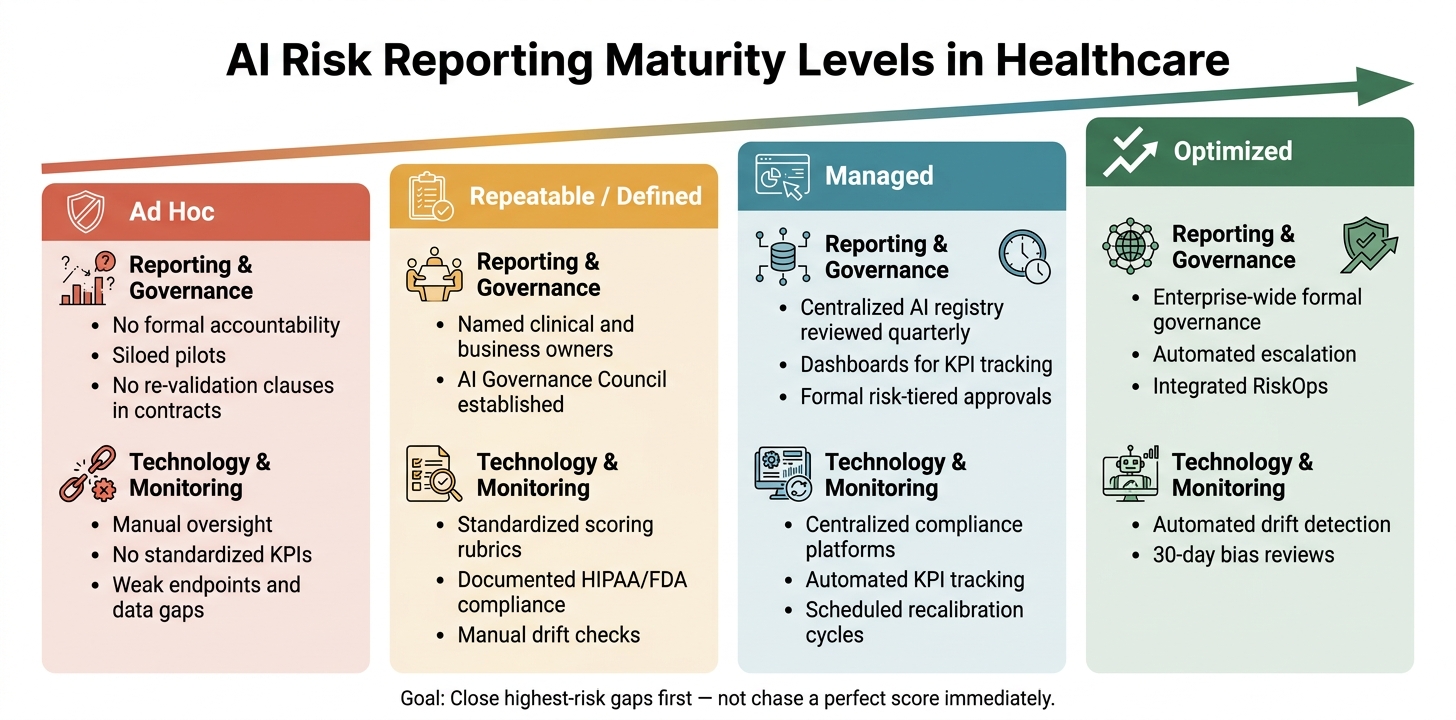
AI Risk Reporting Maturity Levels in Healthcare: From Ad Hoc to Optimized
Use a Maturity Model to Assess Your Current State
Once reporting is in place, the next step is simple: figure out whether it actually works at enterprise scale.
That’s where maturity scoring comes in. Most healthcare organizations still report AI risk in an ad hoc or repeatable way. A maturity model helps you see whether your reporting framework is consistent, auditable, and able to scale across the organization.
It also gives you a clear starting point. No guessing. No rosy self-assessment. Just an honest look at where things stand today.
The table below shows four maturity levels, from siloed pilots to enterprise-wide oversight:
| Maturity Level | Reporting & Governance Capabilities | Technology & Monitoring Enablers |
|---|---|---|
| Ad Hoc | No formal accountability; siloed pilots; no re-validation clauses in contracts | Manual oversight; no standardized KPIs; weak endpoints and data gaps |
| Repeatable / Defined | Named clinical and business owners; AI Governance Council established | Standardized scoring rubrics; documented HIPAA/FDA compliance; manual drift checks |
| Managed | Centralized AI registry reviewed quarterly; dashboards for KPI tracking; formal risk-tiered approvals | Centralized compliance platforms; automated KPI tracking; scheduled recalibration cycles |
| Optimized | Enterprise-wide formal governance; automated escalation; integrated RiskOps | Automated drift detection; 30-day bias reviews |
The point isn’t to chase a perfect score right away. The goal is to close the highest-risk gaps first.
From there, maturity scores should feed the next step: regular audits and management review.
Improve the Framework Through Audits and Management Reviews
Once you define maturity, audits help you move from measurement to correction. Dashboards show the signal. Audits and management reviews drive the fix.
Run bias audits before deployment and again at scheduled intervals after deployment. Use KPI trends, KRI breaches, and incident patterns to decide what needs review first. Then use management reviews to track:
- Incident trends
- Breached KRI thresholds
- Override rates
- Open remediation items
Just as important, track remediation items to closure, not just to assignment.
Visibility on its own doesn’t improve a framework. Reviews have to turn findings into action. If audits show a repeating pattern, like repeated data drift alerts in the same clinical application, that’s not something to simply log and move on from. It’s a sign that escalation rules or recalibration schedules need to change.
Each review cycle should update controls, thresholds, and escalation rules. AI governance has to change as the systems it oversees change.
Conclusion: Core Elements of Effective AI Risk Reporting
Effective AI risk reporting depends on clear ownership, standard metrics, automated evidence capture, and review cycles that turn findings into action.
That means aligning with recognized governance frameworks, assigning ownership across clinical and operational leadership, and tying reporting into both patient safety workflows and cybersecurity operations. Platforms like Censinet RiskOps™ can centralize policies, risks, and tasks in one dashboard. Organizations that build auditable, governance-led reporting now will be in a stronger position as AI oversight gets stricter.
FAQs
How are AI risk tiers assigned in healthcare?
Healthcare organizations usually assign AI risk tiers through a multidisciplinary governance committee and a structured two-step review process.
They often start with a low-risk screening checklist. If a solution doesn't pass that first screen, it moves into a deeper review led by data scientists and business owners.
From there, the organization classifies the AI as low, moderate, or high risk. High-risk tools are then escalated to the committee, which decides whether to implement them, pilot them, or reject them.
What should trigger immediate AI incident escalation?
Immediate escalation should follow any AI-related patient harm or near miss, with prompt notice to clinical leadership and the quality and safety committee. The same goes for major model failures - even if no harm has been documented.
Cyber incidents need to move through the CISO and the organization’s existing breach response process. That includes suspected breaches, adversarial attacks, and model poisoning.
Off-cycle escalation is also required when performance drops below defined safety or operational benchmarks. For example, if error rates go above 5%, the issue should be escalated right away.
Which AI metrics matter most for patient safety?
Healthcare organizations should focus on metrics that show both technical reliability and clinical impact. That means looking closely at accuracy, sensitivity, specificity, and how well a model generalizes beyond the setting where it was first tested. Just as important, teams should check reliability and bias across different demographic groups. A system that works well for one group but slips for another can create serious problems fast.
Real-world safety takes more than a single benchmark score. Organizations should track patient and clinician experience, workflow productivity, and clinical outcomes. They also need continuous monitoring for data drift, concept drift, and performance degradation. In plain terms: even a model that looks good on day one can lose ground as patient populations, care patterns, or input data change.
