
AI is making healthcare attacks faster, more targeted, and more dangerous for patient care. In healthcare, a cyberattack can now mean more than stolen records or locked files. It can also mean altered AI outputs, disrupted devices, and care delays.
Here’s the short version:
- Healthcare is a top target. The FBI reported 249 ransomware attacks on U.S. healthcare institutions in 2023.
- Breaches are expensive. Average healthcare breach costs are about $7.42 million.
- AI speeds up each attack step. It helps with recon, phishing, password attacks, lateral movement, and system abuse.
- Clinical risk is now part of cyber risk. Attacks can hit EHRs, imaging, cloud apps, connected devices, and clinical AI tools.
- Vendor risk is a major weak point. One supplier issue can spread across many hospitals and care sites.
- The main response areas are clear: AI governance, stronger identity controls, and tighter vendor review.
What I take from this is simple: healthcare security teams need to track not just data theft, but also care disruption and bad clinical outputs. That means watching how attacks move from phishing and login abuse into EHR access, device misuse, cloud exposure, and AI model tampering.
A few facts stand out:
- AI-generated phishing has been tied to about 46% click-through, versus about 18% for standard phishing
- Attackers have moved laterally in as little as 51 seconds
- Research found that just 200 to 400 poisoned images can corrupt some radiology models
The big shift is this: healthcare security is no longer only about keeping systems up. It is also about keeping care safe.
If I were summarizing the article in one line, it would be this: the AI kill chain shows where healthcare attacks start, how they spread, and where teams need to block them before they touch patient care.
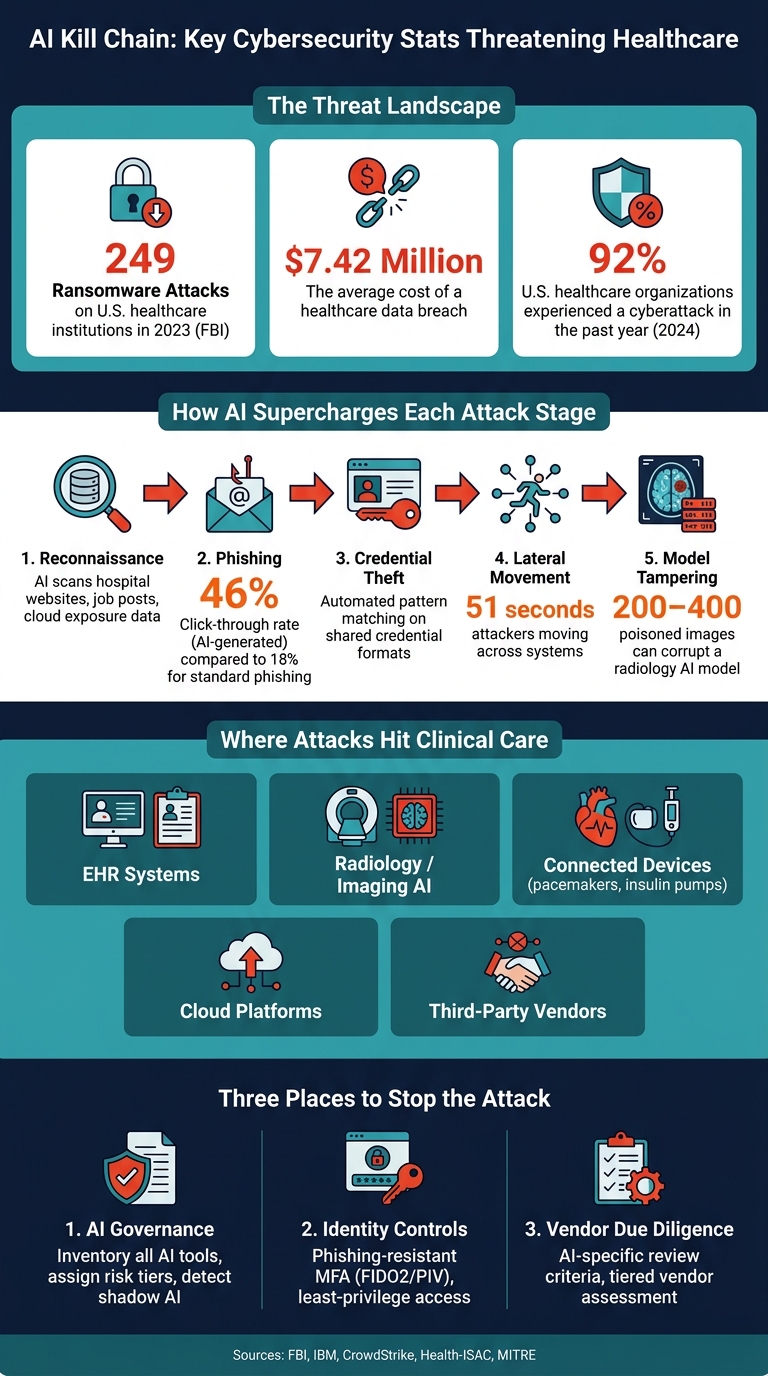
AI Kill Chain: Key Cybersecurity Stats Threatening Healthcare
AI Cybersecurity Risks and Compliance for Healthcare Organizations
sbb-itb-535baee
How AI changes each stage of the attack lifecycle
AI makes each stage of an attack cheaper, more precise, and harder to spot. In healthcare, that problem gets worse because clinical work is messy by nature. There are many systems, many handoffs, and a lot of places where suspicious activity can blend in. The risk stretches across clinical systems, connected device security risks, cloud platforms, and third-party vendors throughout the full attack lifecycle.
Reconnaissance and phishing get faster and more targeted
Attackers can use AI to scan hospital websites, provider directories, job postings, and cloud exposure data to map EHRs, imaging systems, vendors, and misconfigured endpoints. [1][7] Even a job post that mentions a system name or access method can hand over a useful clue. Once attackers have that map, AI can help turn it into targeted lures.
AI phishing kits can generate convincing messages that mirror billing, clinical, or IT workflows. A revenue cycle staff member, for instance, might get a fake payer audit notice. [10] That works because the message doesn't feel random. It feels like part of the day job.
One analysis found about a 46% click-through rate for AI-generated emails, compared with about 18% for standard phishing. [7] One click can expose credentials and give attackers a way into internal systems.
Credential compromise and lateral movement reach clinical systems faster
Attackers can feed breach data into models that predict reused passwords, missing MFA, and trust paths across clinical and vendor systems. [3][7][9] Shared credential formats, like first initial, last name, and hospital code, are easy for automated pattern matching to spot.
That makes one compromised account much more dangerous in healthcare. AI-driven relationship mapping can trace links across EHRs, pharmacy, radiology, backups, and vendor portals in minutes. [5][9] A nurse account might open prescription systems. A vendor's remote support credentials might reach domain controllers. [5][9]
CrowdStrike threat data shows that attackers can now move laterally across environments in as little as 51 seconds. [14] At that point, they aren't stuck at the edge of the network anymore. They can get to the systems that shape care.
Model manipulation and automated exploitation create new clinical risks
AI now threatens more than access. It also puts clinical integrity at risk. Healthcare organizations are using AI in radiology, clinical decision support, documentation, and triage, and those models can be targeted directly.
Data poisoning can plant a hidden trigger in a model by slipping manipulated samples into training data. Research shows that as few as 200–400 poisoned images can compromise a CNN-based radiology model. [13] Adversarial inputs, which are tiny changes to medical images that a person can't see, can flip a model's output from "no stroke" to "acute stroke" without any visible difference to the clinician reviewing it. [4]
The danger doesn't stop at image review. A poisoned clinical decision support tool might quietly shift antibiotic recommendations or cause the model to ignore certain risk factors, which can affect prescribing and care decisions. [11][12] Third-party AI tools can also exfiltrate data or trigger API calls that change device or EHR settings. [2][5][6]
When AI sits inside care workflows, tampering with the model can affect everything downstream. In plain terms, the model doesn't have to fail loudly to cause harm. A small change in output, repeated across many decisions, can ripple through care as clinical AI and connected systems keep expanding.
What the AI kill chain tells us about the future of healthcare security
AI is pushing healthcare cyber risk in a harsher direction: attacks are getting faster, more targeted, and more able to disrupt patient care, not just steal data. You can see that shift across clinical systems, connected devices, cloud platforms, and vendor networks. And it's picking up speed.
Attack speed, scale, and personalization will keep increasing
AI gives attackers a way to run bigger campaigns in less time and with less work. Health-ISAC names AI-enabled attacks as the #1 concern for 2026, warning of a "perfect storm" of ransomware, supply chain attacks, and AI-powered threats.[20][9]
That matters because healthcare teams are easy to target in different ways at once. Clinicians, administrators, and vendor-facing staff can all get lures shaped to fit their jobs, daily routines, and systems. Those lures can hit email, identity tools, cloud apps, and vendor portals at the same time.
Old phishing playbooks start to look slow in that kind of setting. By the time a team spots one campaign, the next variation may already be moving. Security teams need to shift from reactive response to continuous risk monitoring.
Clinical AI and connected care create new integrity and safety risks
In healthcare, a successful attack no longer means only stolen records or locked systems. It can also mean a bad clinical decision. That changes the meaning of a successful healthcare cyberattack.
A narrative review of AI-induced cybersecurity risks in healthcare found that AI-controlled devices such as pacemakers, insulin pumps, and imaging equipment are becoming targets for ransomware and denial-of-service attacks because their connectivity makes unauthorized access easier and more harmful.[5] MITRE's analysis of medical devices adopting AI and cloud shows that attacks can happen at every stage of the AI/ML lifecycle, from training data poisoning to live adversarial inputs, which can weaken both device function and patient privacy.[21]
This is the part security teams can't afford to miss. If a team looks only for data loss, it may miss the risk that matters most in a hospital: patient harm. When AI sits inside care workflows, an integrity failure can turn into a patient-safety failure.
Third-party and fourth-party dependencies expand the attack surface
Hospitals now inherit risk through AI models, training data, cloud services, and remote access tied to third- and fourth-party relationships. If a software vendor adds a third-party AI component, or a device maker depends on a foundation model trained somewhere else, that risk can flow straight into clinical settings without being clear to the hospital's security team.
A threat overview of AI and medical device software warns that transfer learning poisoning of popular foundation models can quietly spread vulnerabilities into many downstream medical devices, creating an AI supply chain attack that is hard to spot.[22] Legacy vendor review processes were not built to catch AI-specific risks like model poisoning, adversarial testing practices, or AI incident response procedures.[17][18][19]
Gaps also show up in day-to-day oversight. Many current controls do not fully cover:
- how vendors collect, label, and use patient data for model training
- how often models are updated
- how performance drops or attacks are detected and reported[15][16][17][18]
Attackers will go after that weak spot. Closing it takes governance, stronger controls, and continuous monitoring.
How healthcare organizations can break the AI kill chain
Healthcare teams can disrupt the AI kill chain in three places: governance, identity, and vendor control.
Build AI governance and risk oversight into your security program
Start by treating AI risk as a formal part of your security program. That includes reconnaissance, phishing, credential compromise, and model tampering. Every AI tool in use should be inventoried, whether it's clinical decision support, imaging algorithms, or admin automation. Then assign risk tiers based on PHI access, clinical impact, and patient-facing use. Use NIST AI RMF Map to inventory AI tools and Measure to score them in the risk register. The goal is simple: stop attackers before they get anywhere near care delivery.
Shadow AI is one of the toughest gaps to close. A 2024 survey found that 92% of U.S. healthcare organizations experienced a cyberattack in the past year.[25] When clinical and admin staff use unsanctioned AI tools, that exposure grows fast. To find shadow AI, look at:
- Network logs
- Procurement records
- Expense data
- Staff surveys
That last one matters more than it may seem. Staff don't always report the tools they depend on every day.[26][27] And blanket bans usually backfire. If people still need the tool to do the job, they'll often go around policy. A better approach is to give staff a fast, clear path to approved options.
Censinet RiskOps and Censinet AI can centralize AI inventories, reviews, and remediation across the many stakeholders involved in healthcare risk management.[23]
Harden identity, messaging, clinical systems, and AI model controls
Identity controls can slow credential theft and lateral movement. Use phishing-resistant MFA such as FIDO2 or PIV for staff and vendors who access EHRs, clinical systems, and sensitive portals.[29] Then add step-up verification for privileged actions, like EHR admin changes or updates to clinical AI settings. Least-privilege access should also apply across AI training environments and data warehouses, so a stolen credential doesn't give an attacker free rein.[30][24]
Messaging defenses need an update too. It's not enough to block known bad domains. AI-generated phishing can look polished, familiar, and alarmingly normal. Tune email defenses to watch for sender identity issues and unusual message patterns. Add brand and domain protection to catch spoofed hospital or vendor domains. And train staff to verify voice or video instructions before acting, especially when deepfakes are in play.
For clinical AI models, put guardrails around the model itself. Use data lineage controls, adversarial testing before deployment, and post-deployment monitoring for drift and unexpected outputs. That helps protect both model integrity and patient safety.[4][8]
Tighten vendor due diligence and continuous monitoring
Vendor review helps close the third- and fourth-party gaps that can stretch AI risk across your ecosystem. For AI vendors, that means looking at model training data, update frequency, and downstream dependencies. A vendor risk program built for standard software won't cover enough ground here. AI needs its own review criteria.
A tiered model helps teams spend time where the risk is highest. Tier 1 vendors - those whose AI handles PHI or affects clinical decisions - should provide documentation on model security controls, training data sources, bias mitigation practices, and adversarial testing procedures. Lower-tier vendors with limited data exposure can move through lighter review cycles. Vendors should also be reassessed after model updates, incidents, and renewals.
Healthcare systems using Censinet RiskOps complete assessments in under a week and reduce review effort.[28] Automating assessments can cut review time and surface gaps faster.
Conclusion: Use the AI kill chain to act before risk accelerates
The AI kill chain gives healthcare teams a practical way to understand how attacks unfold today. It starts with AI-made phishing and moves into automated probing of clinical systems, connected devices, cloud platforms, and vendors. Each step is moving faster, getting more precise, and becoming harder to spot. In healthcare, the damage goes far beyond lost data. Disrupted care workflows, altered clinical AI outputs, and compromised connected devices can affect patient safety directly.[31][32]
That risk gets worse when a vendor becomes the way in. One supplier breach can ripple across many health systems. That's why steady vendor oversight needs to be treated as a core security job, not just a compliance task.
To break that chain, security controls need to match how AI-driven attacks move in practice. Focus on AI governance, phishing-resistant identity controls, behavior-based monitoring across EHRs and clinical systems, and vendor reviews that account for AI-specific risk. Those steps help counter reconnaissance, phishing, credential theft, and model tampering at each stage.
The fastest way to put those controls into day-to-day use is to centralize risk oversight and vendor review. Censinet RiskOps and Censinet AI can bring AI policy, risk tracking, and third-party assessment into one place so teams can act before risk compounds.
FAQs
What is the AI kill chain in healthcare?
The AI kill chain in healthcare is the step-by-step path cyber threats use to compromise clinical systems, medical devices, and admin workflows.
Put simply: it shows how an attacker can move from initial access to outcomes like patient harm, PHI exposure, or operational downtime.
Common stages include reconnaissance, data poisoning, model manipulation or prompt abuse, privilege escalation, and operational impact.
Looking at AI risk as a chain gives security leaders a clearer way to spot weak points and assign ownership before harm occurs.
How can AI attacks affect patient safety?
AI-driven attacks can undermine clinical decision-making in ways that are easy to miss and hard to catch. A medical model might suggest the wrong treatment, miss a diagnosis, or give triage advice that puts patients at risk.
The damage doesn't stop there. These attacks can also disrupt care by flooding staff with alerts, slowing down time-sensitive treatment, or tampering with imaging workflows to hide findings. And because the output may still look normal to clinicians, the harm can keep going without immediate detection.
What should healthcare teams fix first?
Start by inventorying all AI systems and assign clear business and security owners to each one. Put governance first. Set intake and approval controls for any tool that touches ePHI or has any role in clinical decisions.
Then lock down the basics: least-privilege access, audit logging, phishing-resistant MFA, and vendor due diligence for AI-specific risks. That includes data poisoning, fourth-party dependencies, model change control, and Business Associate Agreements for vendors that handle ePHI.
